
How Does an Electro-Permanent Magnet Work?
Understanding the Magnetic Principle Behind Switchable, Energy-Efficient Magnetic Holding
Electro-permanent magnet (EPM) technology combines the controllability of an electromagnet with the energy efficiency of a permanent magnet.
Unlike a conventional electromagnet, an electro-permanent magnet does not need continuous electrical power to maintain its magnetic holding state. A short electrical pulse changes the magnetic state of the system, after which permanent magnetic materials maintain the selected state without continuous power.
This operating principle makes electro-permanent magnet technology particularly suitable for industrial lifting, workholding, automated material handling, laser cutting, CNC machining, and other applications where controlled magnetic force and operational reliability are important.
1. The Basic Principle
The key to understanding an electro-permanent magnet is to distinguish between switching the magnetic state and maintaining the magnetic force.
A conventional electromagnet generates magnetic force by continuously supplying current to a coil. When the electrical current is removed, the magnetic field produced by the coil largely disappears.
An electro-permanent magnet works differently.
Electrical energy is used primarily to switch the magnetic circuit between different magnetic states. Once the desired state has been established, the permanent magnetic materials maintain the magnetic flux without continuous electrical input.
In simplified form:
Short electrical pulse → Magnetic state changes → Magnetic force is maintained without continuous power
This is the fundamental difference between electro-permanent and conventional electromagnetic systems.
2. What Is Inside an Electro-Permanent Magnet?
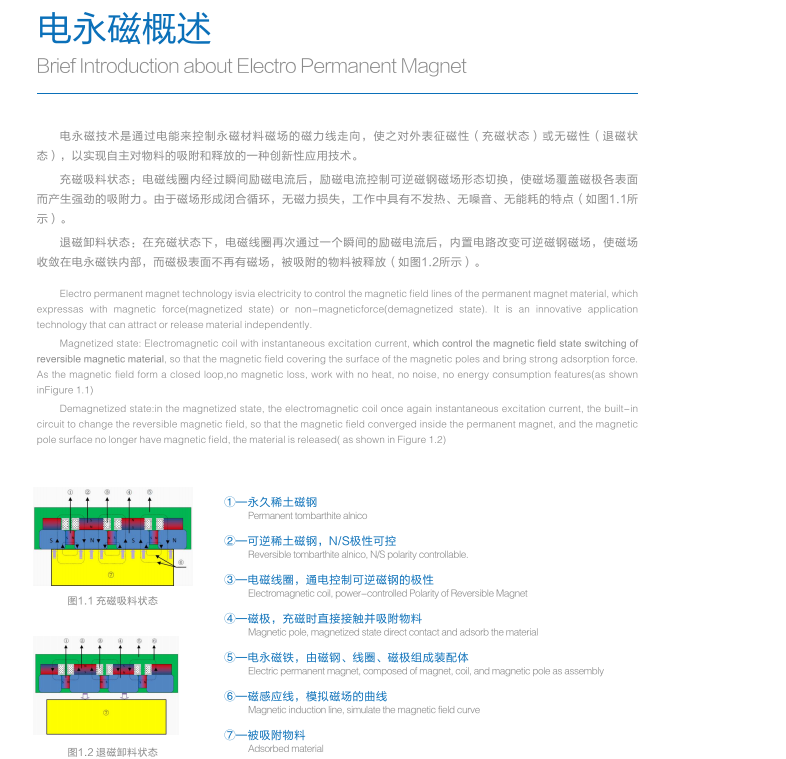
A typical electro-permanent magnet contains several key magnetic components, including:
A high-coercivity permanent magnet, commonly based on NdFeB
A lower-coercivity or reversible magnetic element, often based on AlNiCo in conventional EPM architectures
A switching coil
Soft magnetic components that guide and concentrate the magnetic flux
The two magnetic elements have different magnetic properties.
The high-coercivity permanent magnet is designed to retain its magnetization under the switching field.
The reversible magnetic element can change its magnetization direction when subjected to an appropriately designed magnetic pulse.
The switching coil therefore does not need to generate the entire lifting or clamping force. Its primary function is to change the magnetic state of the system.
This distinction is fundamental to the operating principle of an electro-permanent magnet.
3. How Does the Magnet Turn ON?
When an electrical pulse is applied to the switching coil, it generates a temporary magnetic field.
The pulse is carefully designed according to the magnetic materials, magnetic circuit, and system architecture.
The pulse changes the magnetization direction of the reversible magnetic element while the high-coercivity permanent magnet remains substantially unchanged.
The magnetic flux generated by the magnetic elements is then directed through the external magnetic circuit.
When the magnetic circuit is coupled to a ferromagnetic workpiece such as a steel plate, the workpiece becomes part of the magnetic circuit.
The resulting magnetic flux creates the holding force required to lift, position, or clamp the workpiece.
In simplified terms:
Electrical pulse → Magnetic state switched → Flux directed through workpiece → Magnetic holding force
Once the switching pulse has ended, continuous electrical power is no longer required to maintain the magnetic state.
4. How Does the Magnet Turn OFF?
To release the workpiece, another controlled electrical pulse is applied.
This pulse changes the magnetization state of the reversible magnetic element in the opposite direction.
The magnetic circuit is then reconfigured so that much of the magnetic flux is redirected internally rather than being driven through the external workpiece.
As a result, the external magnetic field at the working surface is greatly reduced, allowing the workpiece to be released.
The switching sequence can therefore be summarized as:
Pulse ON → External magnetic circuit → Holding
Pulse OFF → Internal magnetic circuit → Release
The exact magnetic circuit varies between different EPM designs, so the internal flux path and switching method depend on the specific architecture.
5. Why Does It Not Need Continuous Power?
This is one of the most important characteristics of electro-permanent magnet technology.
A conventional electromagnet requires current to continuously generate its magnetic field.
An electro-permanent magnet, by contrast, stores the magnetic state within its permanent and reversible magnetic elements.
After the switching pulse has established the required state, the permanent magnetic materials maintain that state without continuous electrical input.
Therefore, the electrical system is primarily responsible for switching, rather than continuously holding.
This results in a very different energy profile:
Conventional electromagnet:
Continuous power → Continuous magnetic field → Continuous energy consumption
Electro-permanent magnet:
Short pulse → Magnetic state established → No continuous holding power
The actual energy consumption depends on the switching frequency, pulse characteristics, controller design, and application cycle. Therefore, “no continuous power” should not be interpreted as “zero electrical energy under all operating conditions.” Electricity is still required for switching and control.
6. What Happens During a Power Failure?
The distinction between switching power and holding power also explains an important safety characteristic.
If an electro-permanent magnet is already in its magnetic holding state, the holding force is generated by the permanent magnetic circuit rather than by continuous current in the coil.
Therefore, loss of the external power supply does not inherently cause the magnetic state to disappear.
This is fundamentally different from a conventional electromagnet, where loss of the energizing current causes the generated magnetic field to collapse.
For lifting and workholding applications, this characteristic can provide an important additional layer of operational safety.
However, magnetic lifting safety must always be evaluated as a complete system. Actual lifting capacity depends on factors including material grade, thickness, surface condition, air gap, contact area, magnetic circuit design, load geometry, and the rated capacity of the equipment.
7. Why Is Electro-Permanent Magnet Technology Energy-Efficient?
The main energy advantage does not come from producing a stronger magnetic field with less electricity.
It comes from changing how electricity is used.
A conventional electromagnet continuously converts electrical energy into a magnetic field while holding a load. This continuous current can also produce heat in the coil.
An electro-permanent magnet uses electrical energy primarily during the switching process.
During the holding stage, the permanent magnetic circuit provides the magnetic force without continuous coil excitation.
For applications involving long holding periods, repeated lifting, automated material handling, or multiple magnetic units operating simultaneously, reducing continuous electrical consumption can provide significant system-level advantages.
8. Electro-Permanent Magnet vs. Conventional Electromagnet
The difference can be summarized simply:
Characteristic | Electromagnet | Electro-Permanent Magnet |
|---|---|---|
Magnetic switching | Electrical current | Short electrical pulse |
Continuous holding power | Required | Not required |
Holding force after power loss | Normally decreases substantially | Magnetic state can be maintained |
Heat during holding | Continuous coil losses | Significantly reduced during holding |
Energy consumption | Continuous during energized holding | Mainly during switching |
ON/OFF control | Electrical | Electrical |
Typical applications | Lifting, automation, magnetic actuation | Lifting, workholding, automation, material handling |
The practical advantage of EPM technology is therefore not simply “more powerful.”
It is the combination of:
Controllable + Permanent + Energy-Efficient + Power-Loss Resistant
9. Why Is This Important for Industrial Applications?
Industrial material handling increasingly requires three things at the same time:
Safety.
The magnetic holding state should not depend entirely on continuous electrical power.
Efficiency.
The system should avoid unnecessary continuous energy consumption.
Automation.
The magnetic force should be controlled electronically and integrated with remote controls, PLCs, robots, and automated handling systems.
Electro-permanent magnet technology addresses these requirements by separating the electrical switching function from the magnetic holding function.
This makes EPM systems particularly suitable for applications such as:
Steel plate lifting
Shipbuilding and ship repair
Laser cutting material handling
CNC magnetic workholding
Automated loading and unloading
Steel processing
Injection molding quick mold change systems
Robotic material handling
10. From Magnetic Principle to Industrial Solution
The real value of electro-permanent magnet technology is not simply the magnetic material itself.
It lies in the engineering of the complete magnetic system.
Magnetic circuit design, permanent magnet selection, reversible magnetic elements, pole configuration, switching pulse control, structural strength, thermal management, sensors, control systems, and safety mechanisms all influence the final performance of an EPM product.
For this reason, an industrial electro-permanent magnetic system should be designed according to the actual application rather than selected only by nominal magnetic force.
At QHMAG, electro-permanent magnetic technology is applied to industrial lifting, material handling, workholding, and automation solutions.
Our focus is to combine magnetic engineering with practical industrial requirements to develop safer, more efficient, and more controllable magnetic handling systems.
QHMAG — Electro-Permanent Magnetic Technology for Smarter Industrial Handling.