Electro-Permanent Magnetic Lifting for Faster and Safer Laser Cutting
Laser cutting has significantly improved metal processing efficiency, but material loading, unloading, and handling can still create production bottlenecks. Electro-permanent magnetic lifting provides a controllable and energy-efficient solution for handling ferromagnetic steel sheets and cut parts, helping manufacturers reduce manual handling, streamline material flow, and improve operational efficiency.
Laser cutting has become an essential process in modern metal fabrication. As laser cutting machines become faster and more productive, material handling before and after cutting can increasingly become a bottleneck.
Large steel sheets and finished parts still often require manual loading, unloading, sorting, and stacking. These operations consume labor and can require operators to work close to heavy or sharp-edged materials.
Electro-permanent magnetic lifting provides an alternative approach by combining controllable magnetic handling with the energy characteristics of permanent magnets.
When Material Handling Becomes the Bottleneck
The cutting process is only one part of the production cycle.
After a sheet has been processed, operators may still need to remove the material, separate finished parts, move them to another location, and prepare the next sheet for production.
When these operations rely heavily on manual handling, the actual material flow may not keep pace with the cutting machine.
The result is a common manufacturing problem:
The cutting process is fast, but material handling is slowing down the production cycle.
For large steel sheets, the challenge becomes even greater because of their weight, dimensions, and flexibility.
How Electro-Permanent Magnetic Lifting Works
An electro-permanent magnetic lifting system uses a controlled electrical pulse to switch its magnetic state.
Once activated, the magnetic system can maintain its holding state without continuous electrical power.
For ferromagnetic materials such as steel, magnetic flux passes through the workpiece and creates the magnetic holding force required for lifting and handling.
A simplified operating sequence is:
Short electrical pulse → Magnetic state activated → Material lifted and handled → No continuous power required for holding
A second controlled pulse can switch the magnetic system to its release state.
This principle allows electrical control to be combined with the inherent holding characteristics of permanent magnets.
Full-Coverage Handling for Large Steel Sheets
For laser cutting applications, the distribution of magnetic force is particularly important.
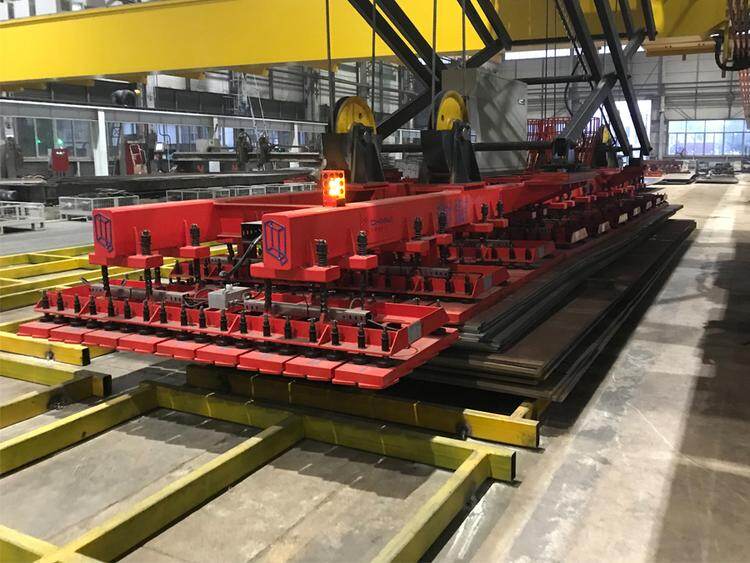
A properly engineered full-coverage magnetic lifting system can distribute magnetic force across a large working area rather than relying only on a small number of concentrated lifting points.
This can help provide more controlled handling of large steel sheets and reduce the need for manual intervention.
Depending on the application, a full-coverage electro-permanent magnetic system can be designed according to:
Sheet dimensions
Material thickness
Material grade
Load weight
Surface condition
Required lifting capacity
Crane or automation configuration
The actual lifting performance always depends on the specific magnetic system and operating conditions.
Faster Loading and Unloading
In high-volume laser cutting operations, loading and unloading are repeated throughout the production cycle.
Electro-permanent magnetic lifting systems can be integrated with cranes, gantry systems, robotic equipment, and automated handling systems to streamline these operations.
Instead of relying entirely on manual lifting and carrying, magnetic handling can become part of the production workflow:
Loading → Laser Cutting → Magnetic Unloading → Sorting → Stacking
This approach can reduce repetitive manual operations and help improve the overall material flow around the cutting machine.
For manufacturers operating high-throughput laser cutting equipment, improving material handling can therefore be an important part of improving overall production efficiency.
Reducing Manual Handling
Steel sheets and laser-cut components can be heavy, large, irregular, or sharp-edged.
Repeated manual handling may increase operator workload and create additional risks when personnel need to work close to the load.
When integrated with appropriate lifting and automation equipment, electro-permanent magnetic systems can allow operators to control material movement from a suitable operating position.
This can reduce direct manual contact with the material and support a more controlled handling process.
However, magnetic lifting safety depends on the complete system design and operating conditions. Material compatibility, thickness, surface condition, air gap, load geometry, rated capacity, lifting procedures, and safety controls must all be considered.
Energy-Efficient Magnetic Holding
Another important characteristic of electro-permanent magnetic technology is that continuous electrical power is not required to maintain the magnetic holding state.
Unlike a conventional electromagnet, which requires continuous current to generate its magnetic field, an electro-permanent magnet primarily uses electrical energy during the switching process.
Once the required magnetic state has been established, the permanent magnetic circuit maintains the holding force.
This can reduce continuous electrical consumption during the holding stage and minimize heat generation associated with continuously energized coils.
The actual energy consumption of a system depends on its design, switching frequency, operating cycle, and control system.
Designed for Automation
Modern laser cutting production increasingly depends on automation.
Electro-permanent magnetic systems can be engineered for integration with:
Overhead cranes
Gantry systems
Robotic handling equipment
Automated loading and unloading systems
PLC-based control systems
Remote control systems
Because the magnetic state can be electrically controlled, EPM technology can be incorporated into automated material-handling sequences.
This makes it possible to move beyond standalone lifting and toward a more integrated production system.
From Cutting Efficiency to Handling Efficiency
Improving laser cutting productivity is not only about increasing cutting speed.
The complete production cycle also depends on how efficiently materials are loaded, unloaded, transferred, sorted, and stacked.
Electro-permanent magnetic lifting can help manufacturers address this part of the process by providing:
Controlled magnetic handling
Reduced manual operations
Faster material transfer
No continuous electrical power for holding
Potential for automation integration
For manufacturers processing large steel sheets and high volumes of cut parts, improving material handling can help remove an important bottleneck from the production process.
QHMAG Electro-Permanent Magnetic Solutions
At QHMAG, we develop electro-permanent magnetic lifting and handling solutions for industrial applications.
Our magnetic systems can be engineered according to the material, dimensions, weight, handling method, and automation requirements of each application.
For laser cutting manufacturers, our goal is to provide magnetic handling solutions that make material movement more efficient, controllable, and suitable for modern automated production.
From loading raw steel sheets to unloading and transferring finished parts, electro-permanent magnetic technology provides a practical approach to improving industrial material handling.
QHMAG — Electro-Permanent Magnetic Technology for Industrial Material Handling.